

How Effective Is The Clean Water Act
David Keiser, Joseph Southward. Shapiro 24 October 2018
Over the last 20 years, the president or the Supreme Court of the Us take restricted, reinstated, then restricted again Make clean Water Human activity protections for roughly half of US waters. 2 Supreme Court decisions in the 2000s –SWANCC andRapanos– removed the Clean Water Human action'south protection for wetlands, intermittent streams, and many other waters. The Obama assistants's Waters of the United states Rule reinstated these protections, and a 2017 executive order past the Trump administration sought to revise or rescind this rule.
The 1972 Clean Water Act has a potent rationale. Before 1972, many Us rivers were polluted to the extent that they would grab burn down, and the 1969 fire on the Cuyahoga River in Cleveland, Ohio provided impetus for the passage of the Make clean Water Human action.
Despite this, the Clean Water Deed has been controversial, for ii reasons. First, there is no clear testify that the Clean Water Act has decreased pollution, or even whether water pollution has fallen(Adler et al. 1993). Second, some fence that the Clean Water Deed'southward costs have exceeded its benefits. These costs have exceeded $i trillion in full (in 2014 dollars). That is more than $100 per person, per year.
Most analyses have concluded that the Clean H2o Act's benefits are smaller than its costs. This includes studies by the Environmental Protection Agency (Lyon and Farrow 1995, Freeman 2000, USEPA 2000a, USEPA 2000b, Keiser et al. forthcoming). This contrasts with analyses of the Clean Air Act, which oft find benefits much larger than its costs (USEPA 1997).
Analyses of the Make clean Water Act have been hampered past 3 challenges:
- limited data on water quality,
- the difficulty of inferring values for clean water by observing human behaviour, and
- separating furnishings of the Clean Water Act from effects of other changes in policy and the economy.
We have tried to shed low-cal on these controversies using the well-nigh comprehensive fix of files on water pollution and its determinants in either academia or regime (Keiser and Shapiro, forthcoming). These include l one thousand thousand h2o pollution readings from more than than 240,000 monitoring sites in the continental U.s.a., from 1962 to 2001. Also we employ detailed records on each of 35,000 grants the federal authorities gave cities in gild to improve the treatment of municipal wastewater.
The analysis finds 3 sets of results.
Water pollution
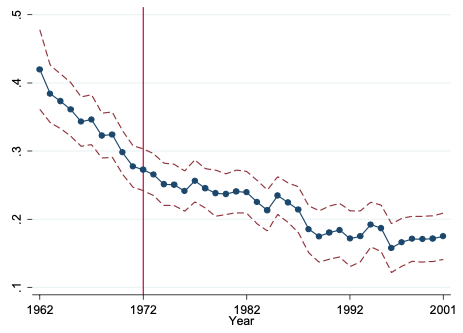
Most measures of water pollution declined between 1962 and 2001, though the rate of decline slowed over fourth dimension. For example, the share of waters unsafe for fishing fell by almost 12% between 1972 and 2001 (Figure 1).
Figure 1 Share of waters not fishable, 1962–2001
Source: Keiser and Shapiro (forthcoming).
Wastewater handling
The assay investigates the consequence on h2o pollution of $650 billion in grants that the federal government gave cities to amend wastewater handling plants. In nearly cities, sewage and other wastes flow through a network of hugger-mugger pipes to a plant that treats the waste product earlier discharging it to a river, lake, or other body of water. Upgrading these treatment plants so that ambient h2o pollution would subtract was a major goal of the Clean Water Deed.
To measure the effects of these grants on pollution, our enquiry compares pollution upstream of a handling plant that received a grant to pollution downstream of the plant. Nosotros did this in years before and later on the grant was received, and in plants receiving grants in early on or belatedly years.
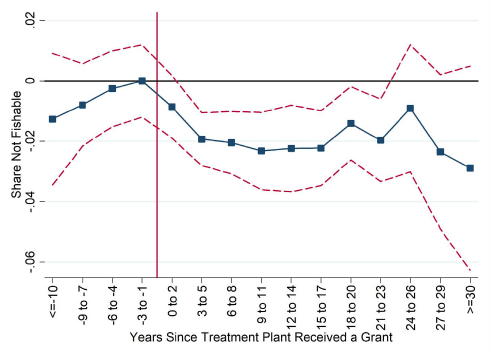
These grants substantially decreased water pollution. The average grant project, which cost around $thirty meg, decreased the probability that downstream waters were dangerous for fishing by about half a percentage betoken (Figure ii). This benefit extended about 25 miles downstream and lasted for almost 30 years. The enquiry as well studies these grants' cost-effectiveness. Information technology finds that, using these grants, it toll nigh $one.5 meg per year to make one mile of a river safe for fishing.
Effigy 2 The furnishings of Make clean Water Deed grants on share of waters non fishable
Source: Keiser and Shapiro (forthcoming).
Home values
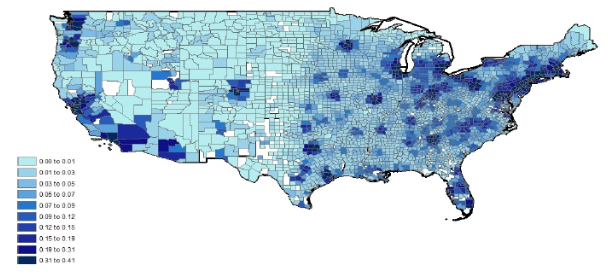
The assay finds some bear witness that these grants increased home values inside a 25-mile radius around the waters that were cleaned up. The aggregate modify in home values, nevertheless, was around ane quarter of the total cost of these grants.
Figure iii Ratio of change in housing values to grant costs by canton
Source: Keiser and Shapiro (forthcoming).
There are several reasons why this ratio of measured benefits (change in home values) to costs of around 0.25 may understate the truthful benefit-cost ratio. People may inaccurately perceive the (especially health) benefits these grants provide. This ratio does non count benefits to people who live more than 25 miles away from the rivers, and information technology abstracts from changes in sewer fees and local taxes.
One interpretation is that the benefits of these Make clean Water Act grants would exceed their costs if the benefits non captured in the housing market assay exceeded the benefits captured here by a ratio of more than three-to-1. Current enquiry is investigating whether existing analyses have underestimated the benefits of cleaning up rivers to this degree, for case by ignoring health benefits, and and then whether the benefits of these investments are greater or less than their costs.
Policy implications
On ane hand, Clean Water Act grants largely concluded by 1988. This new analysis stops in 2001, and the waters targeted by these Supreme Court and federal rules is far from a random sample, considering they focus on wetlands and intermittent streams while the new analysis studies all rivers. In this sense, the new results practise not directly measure any consequences of these current policy changes.
Even so, there are two ways this work may inform current policy debates.
- The Clean H2o Act has decreased The states water pollution. This finding is clearest for pollutants that the Make clean Water Act targeted, while the assay finds less improvement in pollutants primarily from agricultural sources that the Clean Water Act traditionally has not regulated. Thus, removing Clean Water Act protections may increase US h2o pollution, particularly in areas with municipal and industrial discharges.
- The estimated alter in home values due to Clean Water Act grants was smaller than the grants' costs (see Figure 3). This estimated ratio is larger for grants to more densely populated areas. The Clean Water Act, unlike the Make clean Air Act, imposes similar water pollution regulations on most Us surface waters. These findings are consistent with the idea that targeting water pollution regulations so that they focus on waters that are specially important for social welfare could increase the ratio of benefits to costs of these regulations.
Efficient environmental policy balances the benefits and costs of pollution control. For policies such equally air pollution regulation, bachelor show suggests that the benefits of existing regulation justify its costs. For water quality regulation, available show is incomplete, but suggests that re-targeting environmental investments could at least meliorate their net social benefits.
References
Adler, R W, J C Landman, and D One thousand Cameron (1993), The Clean Water Act 20 Years Later, NRDC.
Freeman, A Grand (2000), "Water Pollution Policy", affiliate in Public Policies for Ecology Protection, RFF.
Keiser, D A, C L Kling, and J S Shapiro (forthcoming), "The low merely uncertain measured benefits of US water quality policy",Proceedings of the National Academy of Sciences.
Keiser, D A and J S Shapiro (forthcoming), "Consequences of the Make clean Water Act and the Need for Water Quality",Quarterly Journal of Economicsouthward.
Lyon, R M and Southward Farrow (1995), "An Economic Analysis of Make clean Water Act Issues",H2o Resource Research 31: 213–223.
USEPA (1997), "The Benefits and Costs of the Make clean Air Deed, 1970 to 1990", USEPA word newspaper.
USEPA (2000a), A Benefits Assessment of Water Pollution Control Programs Since 1972: Function ane, The Benefits of Point Source Controls for Conventional Pollutants in Rivers and Streams: Final Report, USEPA.
USEPA (2000b),A Retrospective Assessment of the Costs of the Make clean H2o Act: 1972 to 1997: Final Written report, USEPA.

Source: https://voxeu.org/article/impact-clean-water-act
Posted by: hyderuntly1938.blogspot.com
0 Response to "How Effective Is The Clean Water Act"
Post a Comment